BCM
Business Continuity Management (BCM)
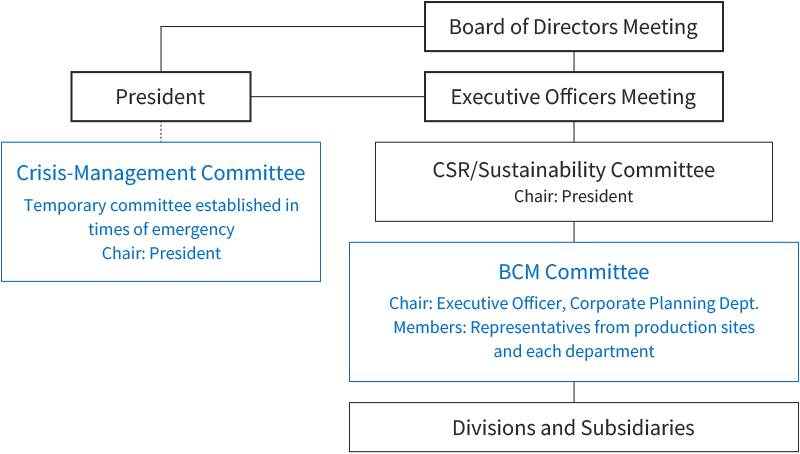
To minimize impact even when disasters occur and fulfill responsibilities to stakeholders, SMK works company-wide to improve its business continuity plan (BCP) combining alternative and local recovery strategies, centered on the BCM Committee established in 2007. Our aim is BCM with multi-hazard response that focuses on resource constraints such as no electricity, unusable buildings, and employees unable to come to work, while considering the unique characteristics of each event such as earthquakes, fires, floods, volcanic eruptions, and infectious diseases.
Governance Structure
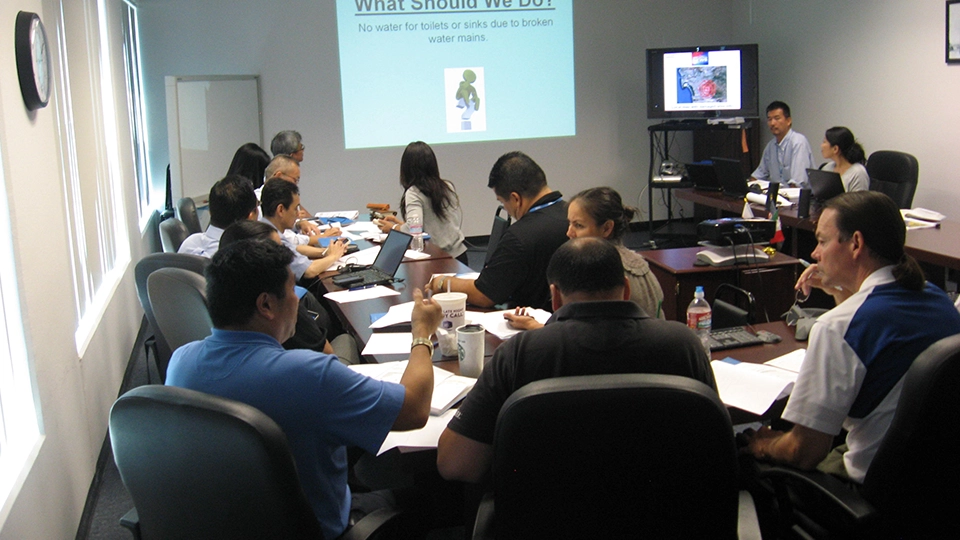
Divisions and production sites proactively conduct initiatives for business continuity efforts, while the BCM Committee confirms the response status of each organization and supports activities. We also work to strengthen individual employees' crisis response capabilities through BCP formulation and training.
IT-BCP
We have developed a BCP for IT systems, critical infrastructure for business continuity, and are enhancing our preparedness for risks such as disasters and cyberattacks.
In formulating a BCP, we conducted a business impact analysis (BIA) to set recovery priorities and target recovery times for IT systems. In the event of a disaster, the pre-assigned response team will follow the recovery manual and these priorities to restore systems. To ensure the effectiveness of the BCP, we regularly conduct drills based on potential business impacts and revise the plan as needed based on the outcomes.
Under normal conditions, we focus on building a disaster-resistant IT system. For critical IT systems, we have installed servers at two data centers in Tokyo and Hokuriku. This configuration enables
mutual backups, allowing operations to continue even if one system becomes unavailable. The adoption of cloud services is also actively underway.
To prepare for cyberattacks, we regularly back up all IT systems and have a framework in place for rapid restoration. In the event of a system failure, a computer security incident response team
(CSIRT) promptly identifies the cause and prevents secondary damage.
Outages that exceed the target response times set by the BIA are classified as serious incidents, and our target for such incidents is zero annually.
Other Major Initiatives
- Sales Activities
- Standardizing processing methods to enable clerical work related to orders to be handled at alternative locations and conducting regular inter-location tests.
- Procurement
- Developing a system to enable rapid alternative procurement.
For more details on supply chain BCM, please refer to the Supply Chain page. - Import and Export
- Assessing and implementing alternative transportation routes.
- Ensuring Personal Safety
- Establishing a system to confirm the safety of employees and their families, ensuring swift business recovery, continuity, and employee support.